
From treating one to treating all: rethinking the economics of autologous CAR-T
As CAR-T therapy continues to expand from hematologic cancers into solid tumors and autoimmune diseases, the discussion around access is evolving. While clinical success has been substantial, the next phase of expanding patient access will increasingly depend on accessibility and cost.
Much recent attention has focused on allogeneic and in vivo CAR-T as potential solutions for affordability. At the same time, a different question is now emerging: can autologous CAR-T itself reach similar economic targets, while preserving its established clinical foundation?
Conventional autologous CAR-T has shown clinical efficacy
The science behind autologous CAR-T is no longer theoretical. Across approved therapies and late-stage clinical trials, CAR-T has demonstrated meaningful clinical benefit in relapsed and refractory hematologic malignancies. Durable remissions have been reported in patients with B-cell lymphoma and other B-cell malignancies (Neelapu et al., 2017; Schuster et al., 2019).
These outcomes established autologous CAR-T as a therapeutic class with curative potential in targeted indications. Health-economic models have also suggested that, under certain assumptions, CAR-T can be considered cost-effective in high-income healthcare systems (Roth et al., 2018; Lin et al., 2019; ICER, 2018).
The question we are facing is no longer ‘whether it works’ but rather ‘how can it be delivered sustainably and at scale?’
Conventional autologous CAR-T has has involved long turnaround times, high costs, and limited access
Despite its clinical success, conventional autologous CAR-T manufacturing remains complex and time-consuming. Standard workflows typically involve centralized processing, multi-week cell expansion, extensive quality control testing, and cryogenic logistics (Shah et al., 2023, Abdo et al.,2025). Moreover, currently available cell processing platforms may also require high-cost consumables.
These steps contribute directly to high treatment costs and limited manufacturing throughput. In multiple myeloma, one analysis estimated that non-acquisition costs alone averaged ~USD 160,000 in the first year after infusion, with total episode-of-care costs approaching ~USD 625,000 when treatment acquisition was included (Jagannath et al., 2023).
As a result, access to CAR-T remains constrained by high upfront costs, long turnaround times, and specialized infrastructure requirements. These limitations have fueled growing interest in allogeneic and in vivo CAR-T, largely because of their proposed path toward lower cost and easier scaling.
GoFast™ is designed for a rapid manufacturing of autologous CAR-T directed at the same targets used in existing disease indications
Alongside alternative CAR-T modalities, a different approach is also taking shape: short-cycle autologous manufacturing. The GoFast™ workflow was developed to support rapid production of autologous CAR-T products while maintaining the same target antigen strategy used in conventional autologous CAR-T programs.” (Ayala Ceja, M., et al.).
Internal evaluations of this short-cycle workflow indicate that rapid manufacturing may be achievable without changing the underlying biological targeting strategy. Within this context, observed in vivo expansion behavior, functional activity, and product consistency are favorable. These observations remain workflow-specific and depend on site implementation and protocol design and are not based on head-to-head clinical comparisons unless otherwise stated.
This suggests that speed and biological fidelity may not necessarily be mutually exclusive.

GoFast™ on MARS Platform: designed to reduce manufacturing COGS
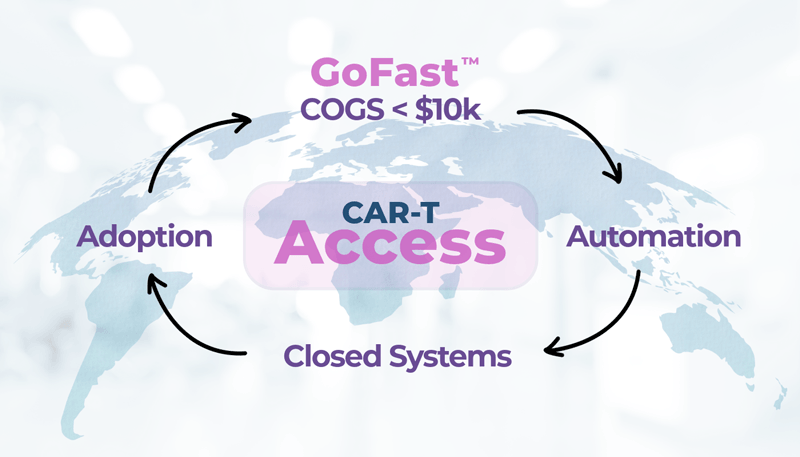
A central driver of CAR-T affordability is manufacturing cost of goods (COGS), which includes materials, labor, quality control, and facility overhead. The MARS® platforms, including MARS Bar or MARS Atlas, when used with the GoFast™ workflow, were designed to address key contributors of these cost drivers simultaneously.
Key design features include:
- Short manufacturing cycles measured in days rather than weeks
- Compact manufacturing footprint
- Closed and automated processing
- A theoretically most minimalized three-step workflow (T-cell selection → CAR transduction → harvest)
- Cost-effective reagent offering (GoFast kit)
Internal cost modeling indicates that, under certain assumptions, this combined approach may support COGS levels less than USD 10,000 per patient sample (internal modeling). This range is within the order of magnitude often discussed for future lower-cost CAR-T manufacturing approaches.
As with all manufacturing economics, these figures are illustrative and depend on local variables such as staffing, vector pricing, throughput, and regulatory testing requirements.
GoFast™ on MARS may achieve further reduced cost when at scale
As manufacturing volume increases, cost may decline as efficiency improves in materials manufacturing, labor/facility cost distribution over a larger number of patient samples, and streamlined QC, including:
- Higher equipment utilization
- Lower per-batch labor input
- Reduced batch failure rates
- Potential scale-down of CAR-T cell numbers per dose as process efficiency and biological understanding continue to advance
Together, these factors suggest that rapid autologous CAR-T manufacturing may continue to move down the cost curve with volume production, rather than remaining tied to today’s centralized, high-overhead model.
Conclusion
Conventional autologous CAR-T has already demonstrated clinical benefit and an established safety profile in reports, but long manufacturing timelines and high costs continue to limit access.
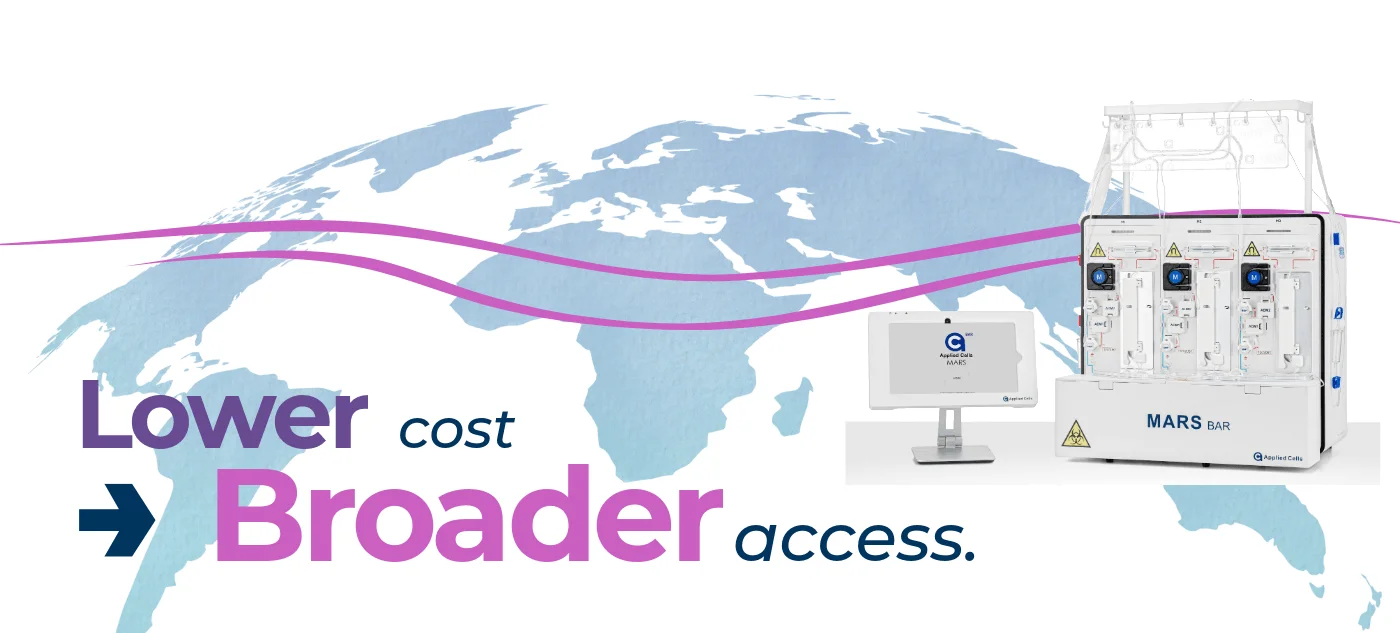
Rapid autologous manufacturing approaches such as GoFast™ on MARS® suggest that autologous CAR-T at lower doses, higher potency, much greater in vivo proliferation, and rapid vein-to-vein time, will have potential to reach clinically viable cost levels that will enable global access of CAR-T therapies, while building on the established clinical foundation of autologous cell therapy.
If these manufacturing trends continue, the curative potential and practical accessibility may finally meet at clinics, supporting broader adoption across more healthcare systems and patient populations.
References
- Neelapu, S. S., et al. “” New England Journal of Medicine 377, no. 26 (2017): 2531–2544.
- Schuster, S. J., et al. “Tisagenlecleucel in Adult Relapsed or Refractory Diffuse Large B-Cell Lymphoma.” New England Journal of Medicine 380, no. 1 (2019): 45–56.
- ICER (Institute for Clinical and Economic Review). Chimeric Antigen Receptor T-Cell Therapies for B-Cell Cancers: Effectiveness and Value. Evidence Report. Boston, MA, 2018.
- Roth, J. A., et al. “Cost-Effectiveness of Axicabtagene Ciloleucel for Adult Patients with Relapsed or Refractory Large B-Cell Lymphoma in the United States.” Journal of Medical Economics 21, no. 12 (2018): 1238–1245.
- Lin, J. K., et al. “Cost Effectiveness of Chimeric Antigen Receptor T-Cell Therapy in Relapsed or Refractory B-Cell Lymphoma.” Journal of Clinical Oncology 37, no. 24 (2019): 2105–2119.
- Jagannath, S., et al. “Component Costs of CAR T-Cell Therapy in Addition to Treatment Acquisition Costs in Patients with Multiple Myeloma.” Oncology and Therapy 11 (2023): 263–275.
- Shah, M., et al. “Promises and Challenges of a Decentralized CAR T-Cell Manufacturing Model.” Frontiers in Transplantation 2 (2023): 1238535.
- Ayala Ceja, M., et al. “CAR-T Cell Manufacturing: Major Process Parameters and Next-Generation Strategies.” Journal of Experimental Medicine 221, no. 2 (2024): e20230903.
- Abdo, L., et al. “Cost-Effective Strategies for CAR-T Cell Therapy Manufacturing.” Molecular Therapy Oncolytics 33, no. 2 (2025): 200980.
- Roth, J. A., et al. “Cost-Effectiveness of Axicabtagene Ciloleucel for Adult Patients with Relapsed or Refractory Large B-Cell Lymphoma in the United States.” Journal of Medical Economics 21, no. 12 (2018): 1238–1245.
Disclaimer:
This article is provided for informational and educational purposes only. It is intended to share general insights into global trends in cell therapy development, affordability, and manufacturing innovation. Nothing contained herein should be interpreted as medical advice, clinical guidance, treatment advice, investment recommendation, regulatory direction, or an offer to provide any therapy, clinical service, or commercial commitment.
All figures, ratios, and cost estimates — including GDP per capita comparisons, affordability metrics, and cost-of-goods (COGS) thresholds — are approximate and intended for illustrative discussion only. These values may be based on publicly available economic data, rounded calculations, generalized industry benchmarks, internal modeling, or scenario-based assumptions, and should not be interpreted as definitive economic analyses, reimbursement expectations, commercial forecasts, or pricing commitments.
Product specifications, workflow descriptions, performance observations, and cost targets related to the MARS® Bar, MARS Atlas™, and GoFast™ platforms reflect internal evaluations, prototype configurations, modeling assumptions, or vendor-reported design goals unless explicitly stated otherwise. Such information is preliminary in nature and may not be peer reviewed, independently validated, reproducible across sites, or predictive of future technical, manufacturing, clinical, or commercial outcomes. Actual results may vary depending on implementation, indication, protocol design, staffing, scale, materials pricing, regulatory requirements, and local operating conditions. Applied Cells makes no representation or warranty, express or implied, regarding the completeness, accuracy, or currency of such information.
References to external studies, approved therapies, clinical outcomes, disease indications, or health-economic analyses are drawn from independent publications and public sources and do not constitute evidence that the same outcomes, characteristics, or economics can be achieved using Applied Cells products, workflows, or platforms unless explicitly stated. Any discussion of durability, potency, proliferation, consistency, turnaround time, scalability, affordability, or access is descriptive, conceptual, or forward-looking only and must not be interpreted as a claim of clinical efficacy, safety, curative effect, therapeutic benefit, equivalence, non-inferiority, superiority, or regulatory approval.
Any references to other manufacturing approaches or CAR-T modalities, including allogeneic or in vivo approaches, are included solely for scientific and market context. They should not be interpreted as head-to-head comparisons, competitive claims, or statements that any Applied Cells technology matches, exceeds, replaces, or will achieve the same or better performance, cost, scalability, or clinical utility as any third-party platform, product, or method.
MARS® Bar, MARS Atlas™, and GoFast™ are for research use only and are not cleared, approved, or authorized by any regulatory agency for diagnostic or therapeutic clinical use. Nothing in this article should be interpreted as promoting clinical use of a research-use-only product.
Applied Cells, Inc. reserves the right to modify product specifications, performance statements, or documentation at any time without notice. The content is provided “as is,” without warranties of any kind, and Applied Cells assumes no liability for any use, interpretation, business decision, or reliance upon the information presented.
