
Cutting the costs: strategies for more affordable CAR-T cell manufacturing
MARS® Bar supports the core rapid CAR-T manufacturing process; for programs that also require freezing, storage, thawing, and surrounding process steps, Applied Cells and Tofflon provide a broader end-to-end workflow.
CAR-T cell therapy continues to expand beyond hematologic malignancies into autoimmune disease, solid tumors, and other emerging areas of cell therapy research. As the field grows, manufacturing remains one of the practical barriers to broader clinical translation.
Traditional CAR-T workflows can involve leukapheresis, PBMC preparation, target-cell isolation, activation, transduction, extended expansion, washing, formulation, and quality testing. Depending on the process, manufacturing alone may take 7–14 days or longer. The most direct way to address this challenge is to start with the core manufacturing process itself. Applied Cells developed the GoFast™ CAR-T workflow around MARS® Bar to shorten and simplify the path from starting material to CAR-T harvest. For programs that also require cryopreservation, controlled-rate freezing, storage, thawing, or additional surrounding process steps, the workflow can then be extended through the broader Applied Cells–Tofflon collaboration.
GoFast™ CAR-T: start with the core rapid manufacturing workflow
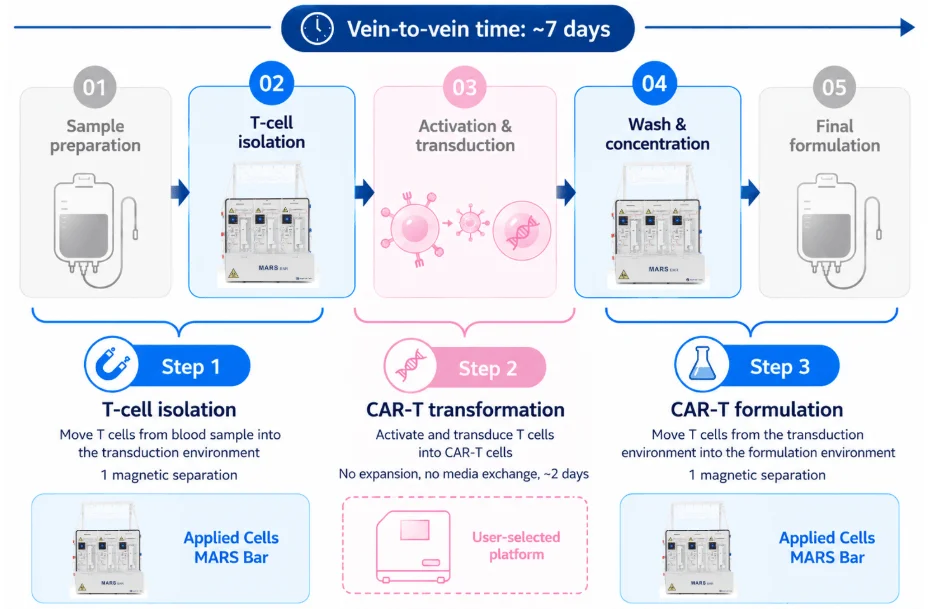
The GoFast™ workflow uses MARS® Bar for T-cell isolation and final wash/concentration, with only one user-selected peripheral instrument required for activation and transduction.
A closed, streamlined manufacturing approach
Why column-free separation matters
Magnetic cell separation is a critical upstream step in many cell therapy workflows. In conventional packed-column systems, magnetically labeled cells enter a physical column, are retained in a magnetic field, and are then recovered through washing and elution. Performance can therefore be influenced by factors such as column structure, sample viscosity, cell concentration, flow rate, and elution conditions.
MARS® Bar takes a different approach. Its column-free design captures magnetically labeled cells within a flowing system, avoiding direct interaction between cells and column-packing material. This approach is designed to provide greater flexibility across different cell quantities, sample volumes, and process configurations.
Flexibility for different starting materials and bead strategies
The platform is designed to work with magnetic bead systems spanning approximately 50 nm to 4.5 μm, giving process developers flexibility to evaluate different bead strategies on the same instrument.
Not every CAR-T program begins with a standard leukapheresis volume. Early-stage research, translational studies, pediatric applications, and other specialized workflows may involve lower starting cell numbers or smaller sample volumes. MARS® can be adapted for inputs including small-volume apheresis samples, cord blood, low-cell-count materials, peripheral blood volumes of 50 mL or less, and other precious samples where minimizing transfer loss is important. Actual minimum sample volume and cell number depend on tubing configuration, cell type, and project-specific validation.
T-cell isolation performance in the reported workflow
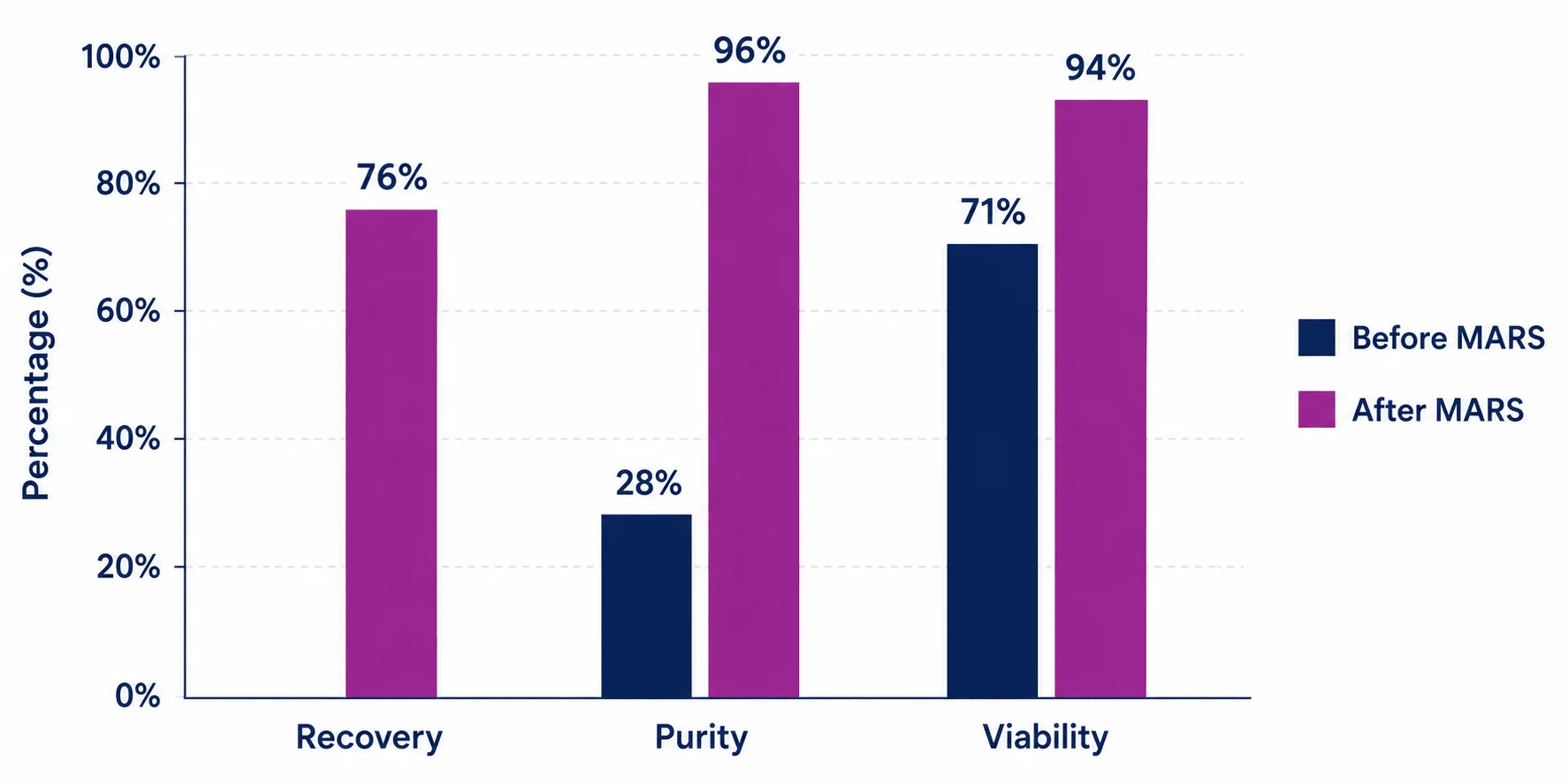
Example T-cell separation data showing recovery, enrichment in T-cell purity, and cell viability following MARS® processing.
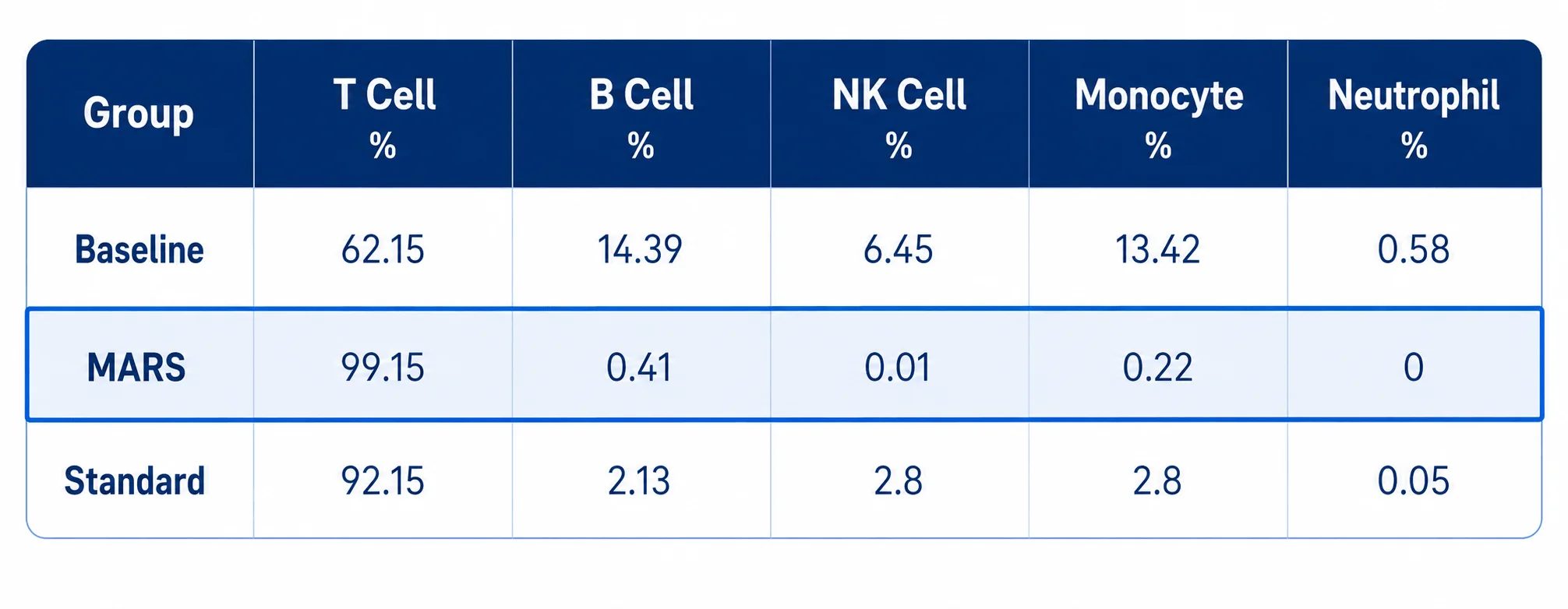
Comparison of starting-material cell composition with MARS®-processed and standard-workflow fractions, illustrating enrichment of the T-cell population.
When cryopreservation is needed: extend GoFast™ into a full end-to-end workflow
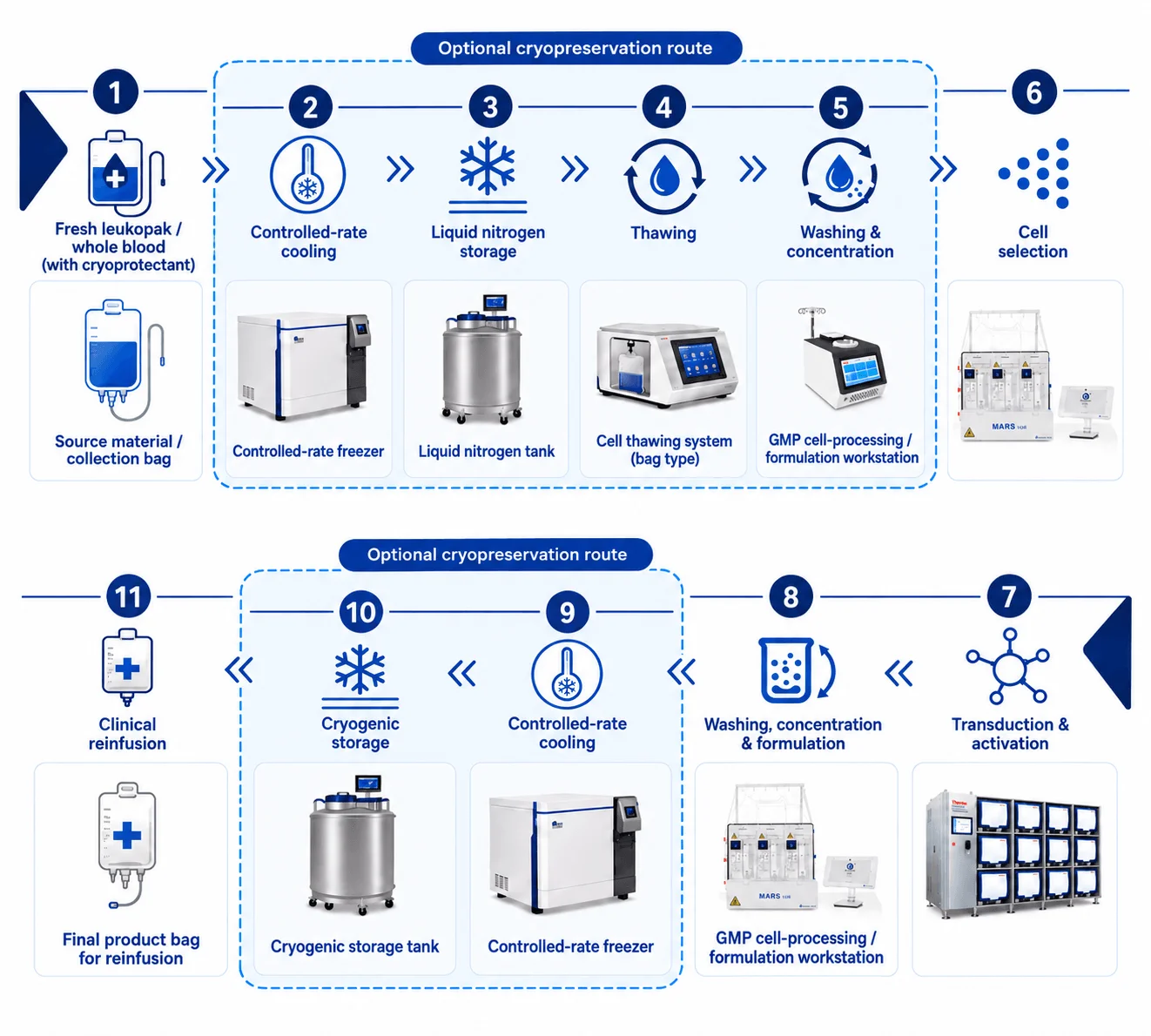
When cryopreservation is required, the GoFast™ core workflow can be extended with complementary Tofflon systems for controlled-rate freezing, cryogenic storage, thawing, culture, and formulation, while MARS® Bar remains the central platform for cell-selection and harvest operations.
A modular path to rapid CAR-T manufacturing
Interested in discussing rapid CAR-T manufacturing or how MARS® Bar and GoFast™ could fit into your workflow? Contact us to learn more.
Note: This blog post has been adapted from the original Tofflon WeChat article developed around the Applied Cells–Tofflon collaboration. The original technical flow, reported data, and figure sequence have been retained, while the text has been edited and reformatted for an English-language Applied Cells blog audience.
*For Research Use Only. Not for use in therapeutic or diagnostic procedures.
