
Following the recent Courier Mail coverage of Pathology Queensland’s multiple myeloma testing program, the MARS® platform has now been featured again by Queensland Health in the article “World-first tech fast tracking cancer diagnosis for Queenslanders”, highlighting the impact of improved plasma-cell enrichment on genomic testing workflows in Queensland.
The growing attention reflects an important challenge in multiple myeloma testing: the cells that laboratories need to analyze can represent only a small fraction of the original sample. For genomic methods such as FISH, the quality of the result depends heavily on having enough target plasma cells available for analysis. When those cells are rare, inefficient enrichment can reduce the diagnostic yield of the downstream workflow. At Pathology Queensland, the introduction of MARS® Bar Flex has helped address this bottleneck.
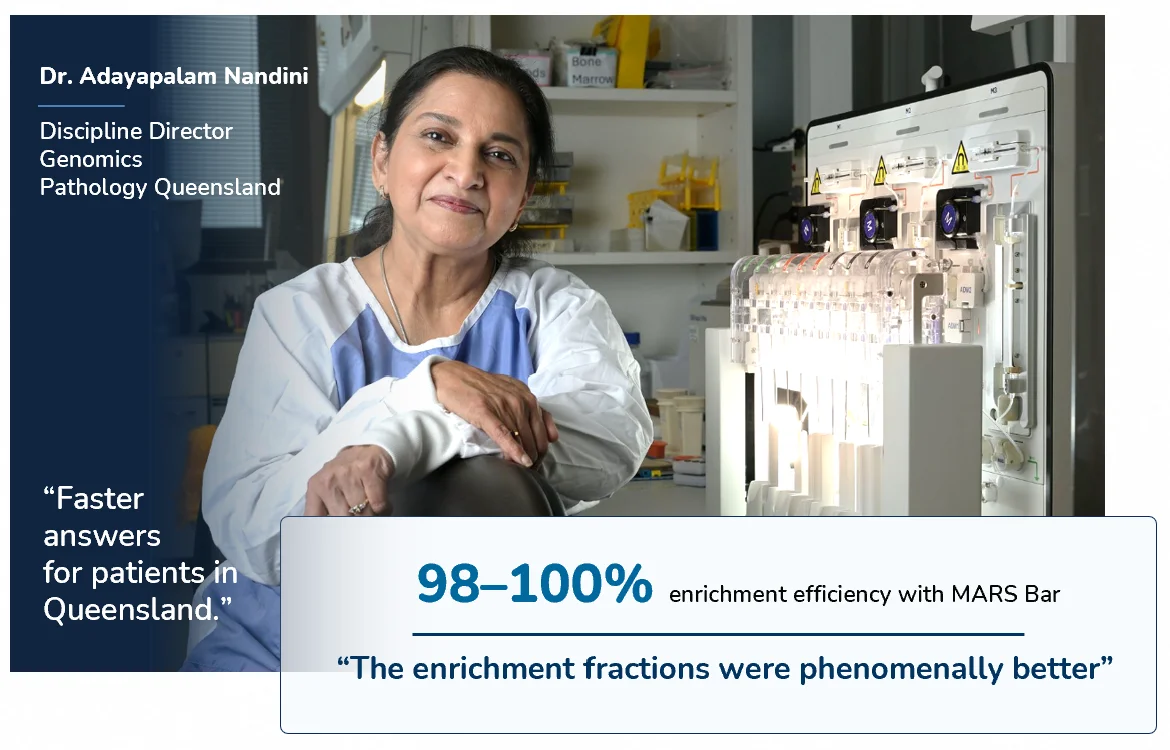
Dr. Adayapalam Nandini, Discipline Director Genomics at Pathology Queensland, reported 98–100% enrichment efficiency with MARS® Bar Flex, compared with approximately 60% achieved with other platforms, describing the resulting enrichment fractions as “phenomenally better.”
But the significance goes beyond the enrichment percentage itself.
Finding more information in difficult samples
Multiple myeloma can involve several genetic abnormalities, and identifying those lesions can provide important information for disease characterization and treatment planning.
By increasing the proportion of plasma cells available for downstream analysis, enrichment can help laboratories detect abnormalities that may otherwise be difficult to identify when the target population is scarce.
The Queensland team has now processed approximately 150 cases using the workflow and reported identifying abnormalities in substantially more patients than with its previous approach.
This is particularly relevant for samples arriving from regional centers. In the original Courier Mail report, Dr. Joel Wight of Townsville University Hospital described the technology as a “game changer for regional patients,” where sample transport and low target-cell numbers could previously make successful testing more difficult.
Where MARS® fits into the workflow
MARS® Bar Flex uses automated, in-flow immunomagnetic cell separation to enrich target populations from complex biological samples.
For multiple myeloma research workflows, CD138+ plasma cells can be enriched directly from bone marrow before downstream analysis such as FISH, helping concentrate the cells of interest while reducing the number of non-target cells carried into the assay.
The goal is straightforward: More target cells → a more informative downstream sample → a better opportunity to detect relevant abnormalities.
Applied Cells has also evaluated MARS®-based CD138+ enrichment in multiple myeloma samples. In a 20-sample study, enrichment before FISH increased the proportion of cytogenetically abnormal cells detected compared with a column-based enrichment method, with additional positive probes identified in several cases.
Learn more about the MARS® CD138+ plasma-cell enrichment workflow
Looking toward more comprehensive genomic profiling
The work in Queensland is also continuing to evolve. Dr. Nandini has described plans to expand the approach toward more comprehensive genomic profiling in multiple myeloma, building on the improved target-cell enrichment now available to the laboratory.
For Applied Cells, this is an important example of how cell separation can influence much more than an individual processing step. When rare target cells are recovered more effectively, laboratories can extract more information from the samples they already receive—and potentially make challenging downstream genomic workflows more successful.
Read the new feature:
Queensland Health
Read the original Courier Mail story:
Revolutionary machine offers Queensland blood cancer patients access to faster treatment
Explore MARS® for CD138+ plasma-cell enrichment:
CD138+ plasma-cell enrichment workflow
For Research Use Only. Not for use in therapeutic or diagnostic procedures.
